Company
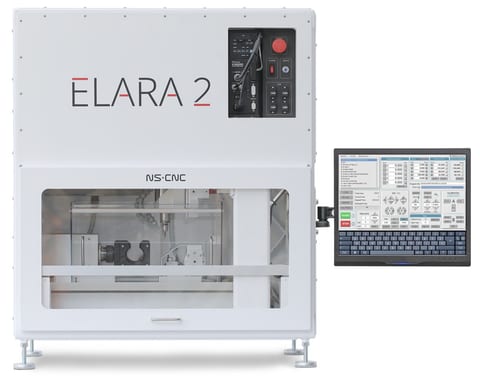
The Elara 2 is a high-precision desktop CNC milling machine manufactured by NS CNC, built for scientific, aerospace, and precision manufacturing applications. It mills materials ranging from waxes and plastics to hard metals and ceramics.
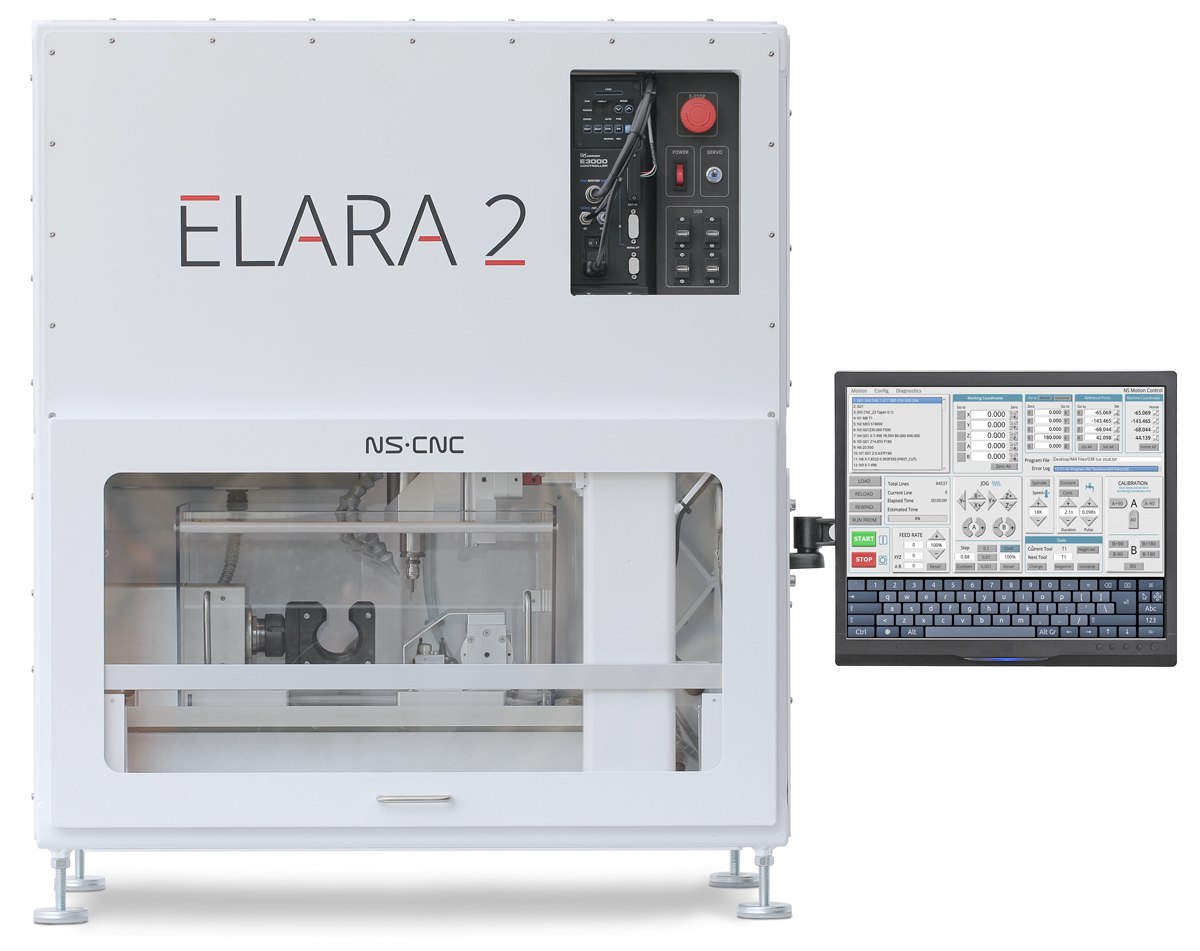
Designed for ultra-precision micromilling and microdrilling - operating milling cutters and drills with diameters as small as 5 microns.
High-precision mechanical components, a specialized carriage design, and optimized lubrication and cooling let the Elara 2 run milling cutters and drills down to 5 microns in diameter.
The capability is utilized in microfluidics, miniature device fabrication, and precision instrumentation.
Everything here comes off the spec sheet - the full table is further down the page.
Resolution - the smallest move it can make: 0.0003 mm (0.3 μm). Positional accuracy - how close it lands to a target: 0.008 mm. Repeatability - how exactly it returns to the same position, cut after cut: 0.010 mm.
Designed for ultra-precision micromilling and microdrilling, the Elara 2 operates milling cutters and drills with diameters as small as 5 microns - for microfluidics, miniature device fabrication, and precision instrumentation.
Cutter tip runout of less than 1 micron delivers high machining accuracy, superior surface finishes, and extended tool life. Three standard E3000-series spindle options, all rated to 60,000 RPM.
3-axis, 3-axis with ATC, 4-axis, and 4-axis with ATC - all built on the same rigid base and proven three-axis platform. Custom configurations are available upon request.
The X table carries threaded mounting holes at 25 mm intervals for fixtures, rotary heads, and sub-tables. Quick-Release Holders position and repeat within 1 micron.
110 or 220 VAC at roughly 1,000 W. Compressed air (21.7–36.2 psi) is required only for ATC configurations. At 838 × 560 × 965 mm and 200 kg, a sturdy bench or the optional stand is the only foundation it needs.
The Elara 2 has the same base, mechanical components, and control system across all configurations, but by installing an additional rotary head and ATC, it can be configured in four different standard configurations. In addition to these standard configurations, NS CNC can custom-make any fixture or workpiece holder.
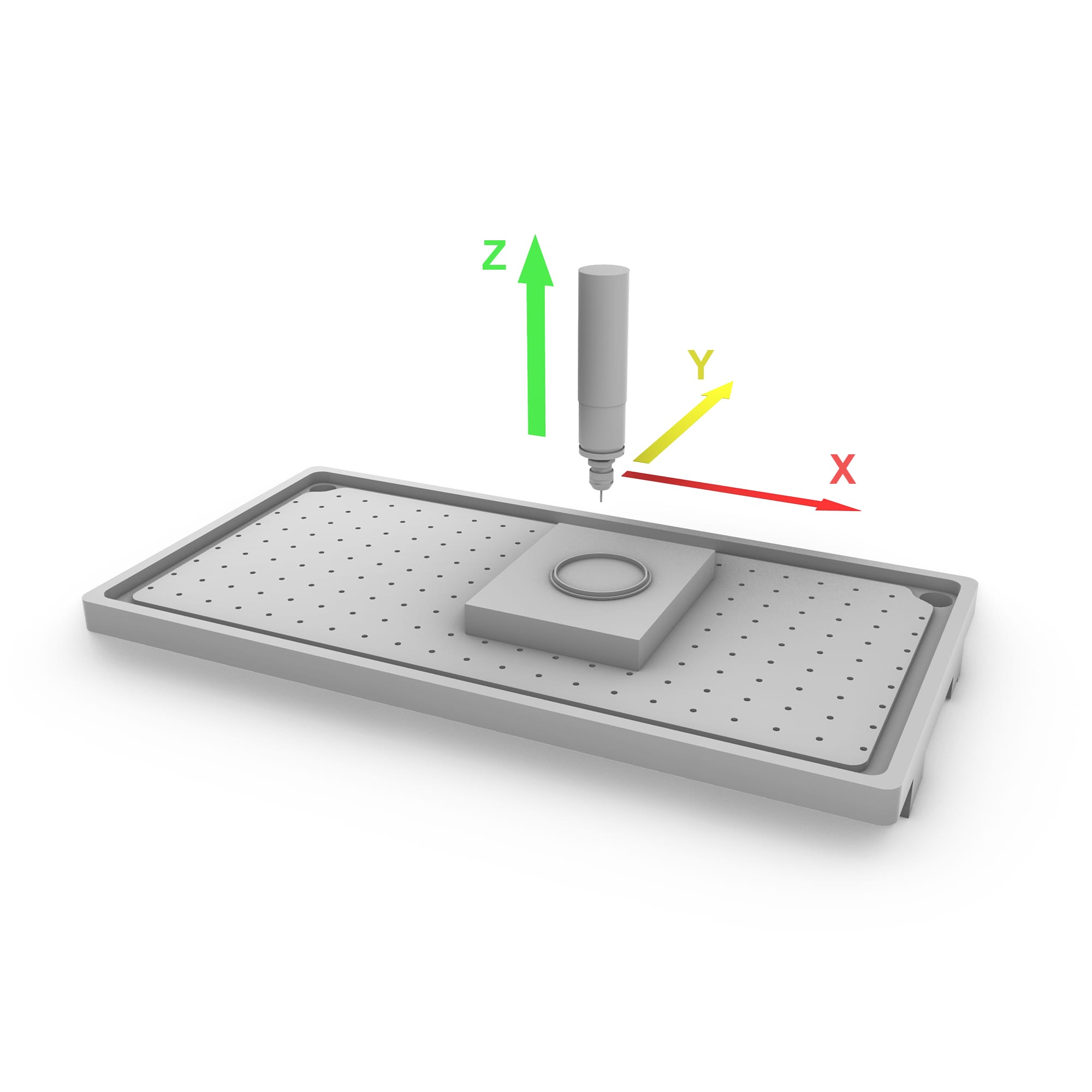
Standard 3-Axis configuration for flat part milling. The workpiece is clamped directly to the X Table to maximize stability. The tool is changed manually in the spindle collet using two wrenches.
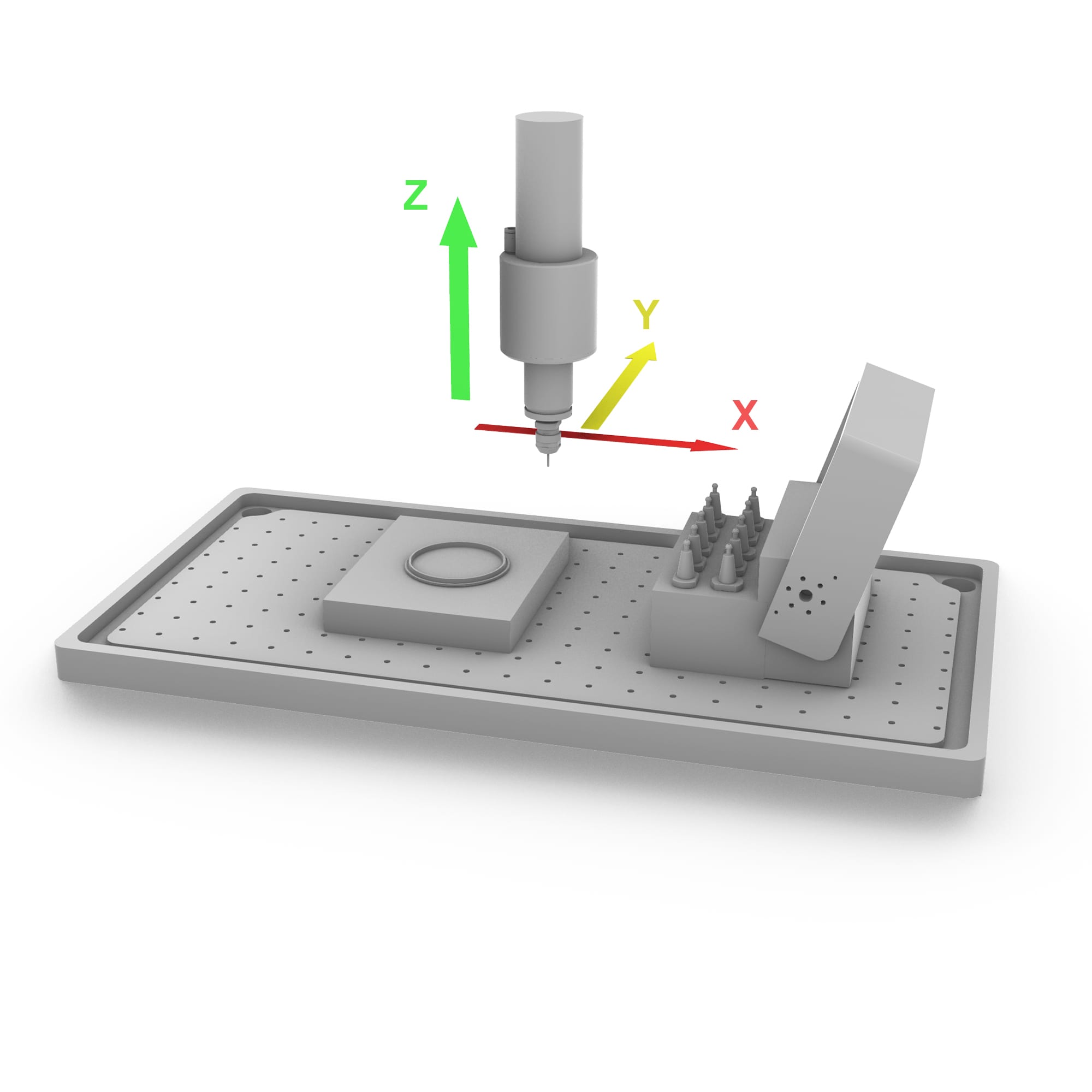
The 3-Axis machine has been updated with a 10-tool ATC and a spindle with a pneumatic clamping system, which requires air supply. Milling bits are changed automatically using the standard M6 command.
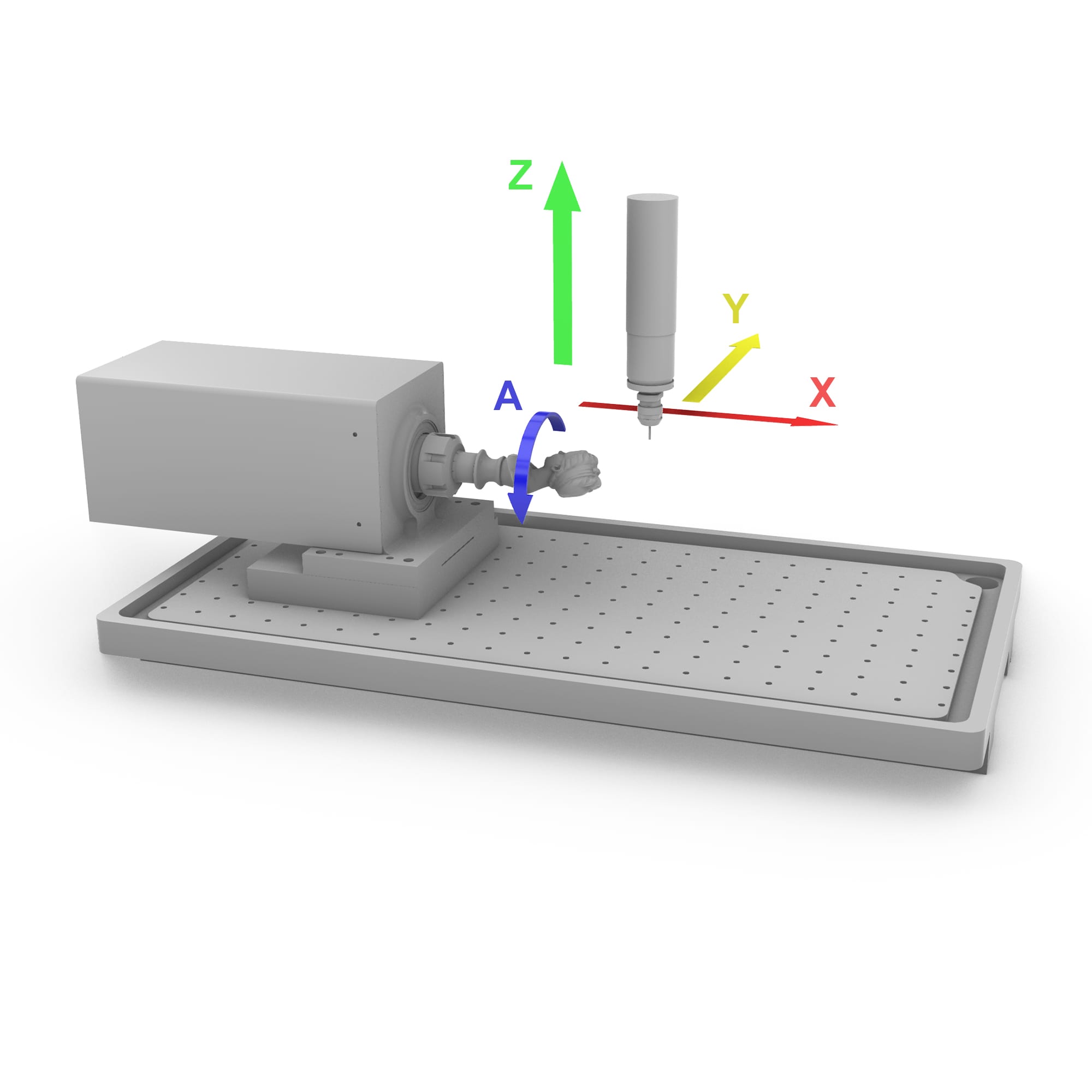
The machine is equipped with Rotary Head (A-Axis) mounted along the X Table. The Head allows for various rotary milling operations. Enables combined 3-axis and 4-axis operations.
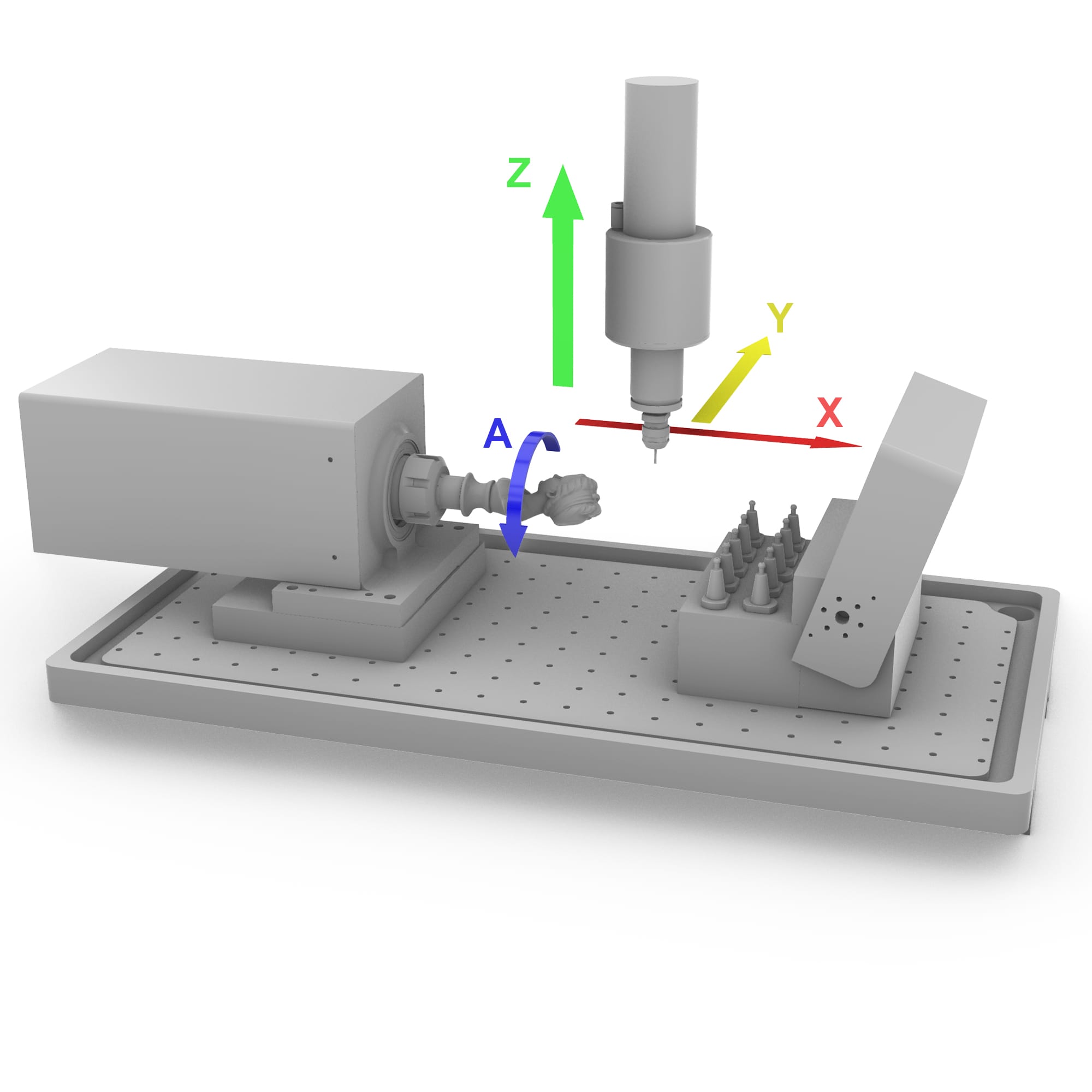
The most advanced standard configuration, which requires extensive operator experience and also takes into account that the more additional equipment is installed on the X table, the less working area remains.

Equipped with Nakanishi spindles, known for high reliability, long-term durability, and low vibration.
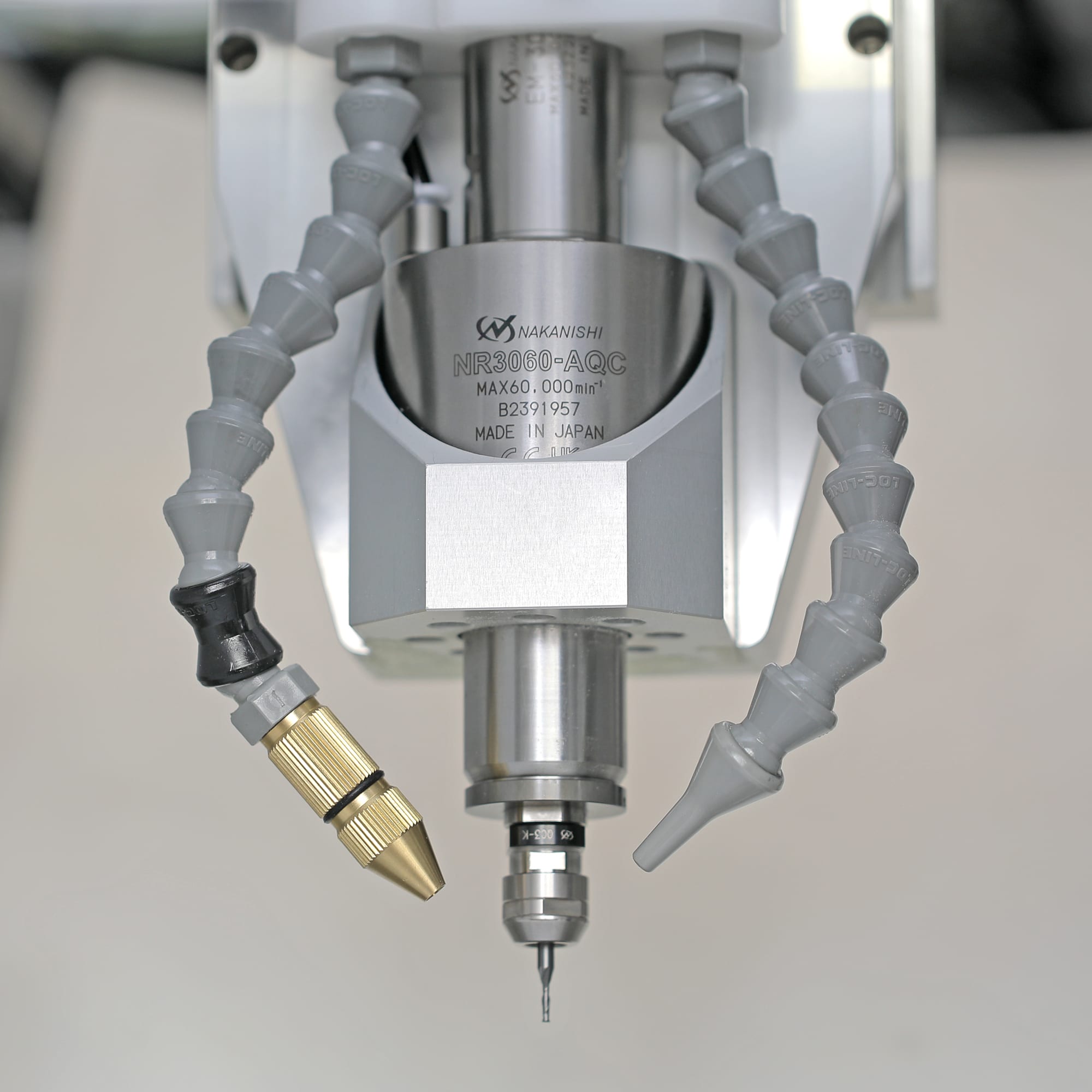
The Nakanishi E3000 is the spindle NS CNC builds its Elara 2 around, accurate to within 1 micron, tight enough that cutter-tip runout, not the spindle, limits surface finish and tool life. An air-bearing variant pushes even further for ultra-precision work.
Its reputation rests on durability, not peak specs. At 60,000 RPM and 350 W, it keeps running unattended in coolant and chips for years, which is why it's still the default choice for CNC lathes and production cells worldwide, machining everything from medical bone screws to watch movement components to consumer-electronics glass.
Nakanishi backs this with about 90% in-house production and a worldwide service network. The E3000 comes in manual, quick-release (QC), and pneumatic automatic (AQC) configurations, the same three options NS CNC offers on the Elara 2, with accuracy fixed at 1 micron across all of them.
The company behind it, NAKANISHI INC., traces back to 1930 and was formally established in 1951 in Kanuma, Japan, where it's still headquartered. Now a publicly traded company (Tokyo Stock Exchange: 7716) with over 2,200 employees across dental, surgical, and industrial divisions, it still markets its spindles under the same "Made in Japan" standard it built its reputation on.
The ideal choice depends on your milling type, material requirements, preferred tool-change method, and production goals.
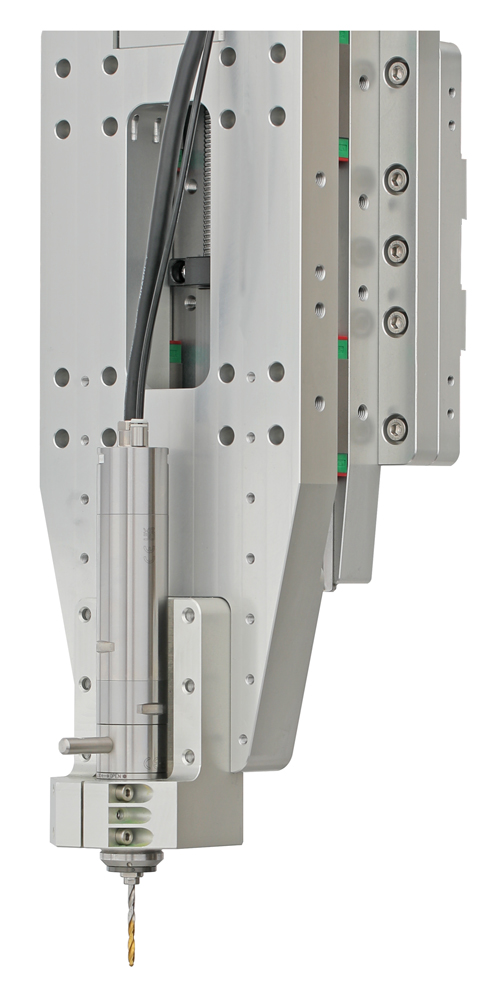
Designed primarily for machining soft materials and not recommended for metal cutting. It accepts a limited range of collet sizes, which is adequate for standard milling cutters but can be restrictive when using drills or other tooling with varying shank diameters.
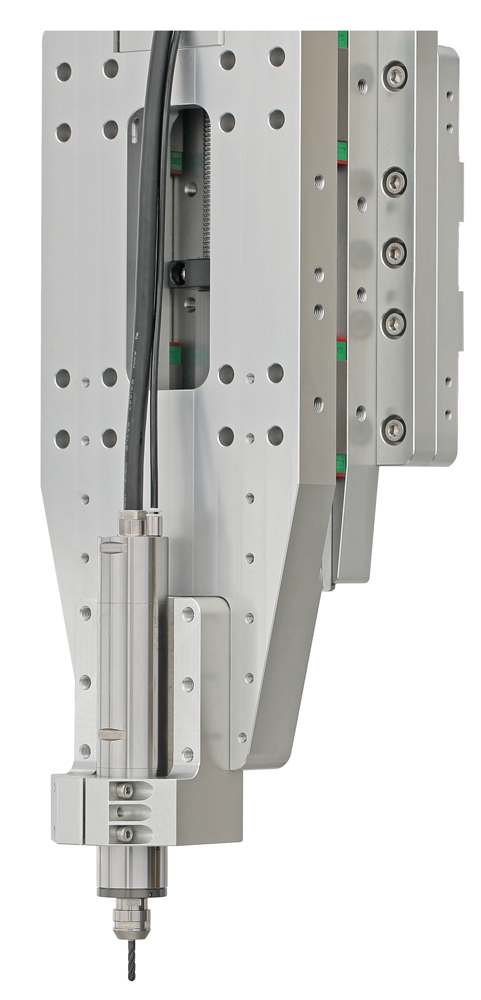
The most widely selected spindle for metal milling when automatic tool changing is not required. It is engineered for exceptional reliability and long-term continuous operation, including in environments with high levels of dust, chips, and other machining debris.
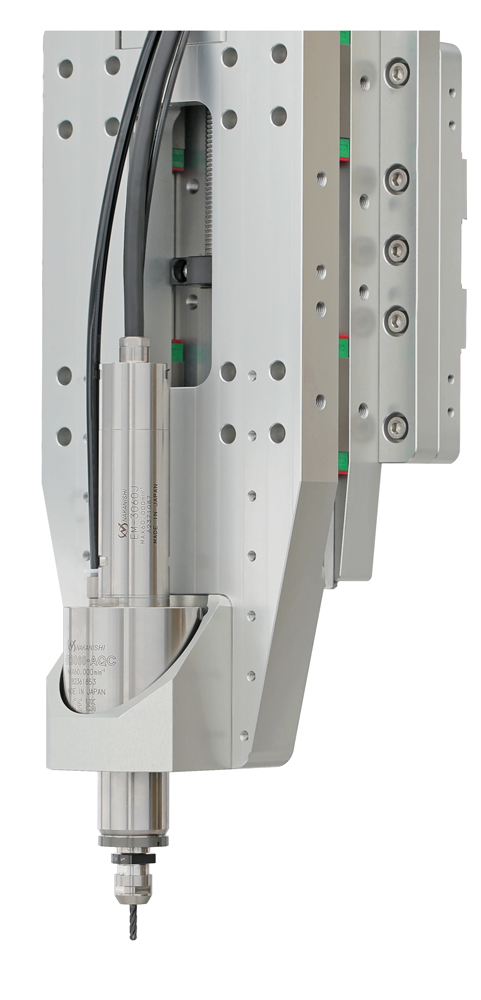
The most advanced and highest-cost spindle, equipped with ATC. It is intended for highly complex machining operations requiring frequent changes between multiple cutting tools. A compressed-air supply is required for automatic tool changing.
A pneumatic system using miniature conical tool holders for precise, repeatable exchanges.
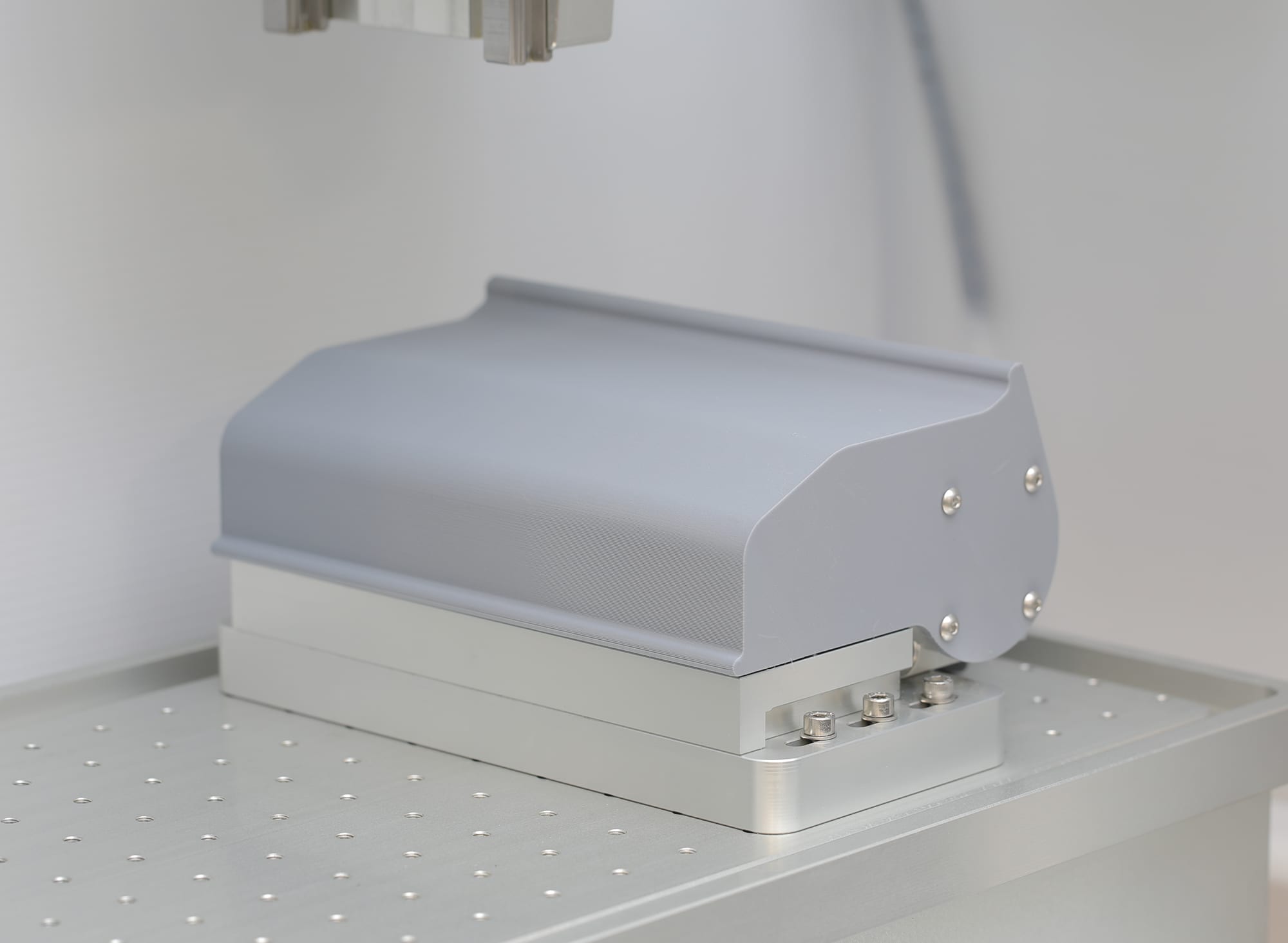
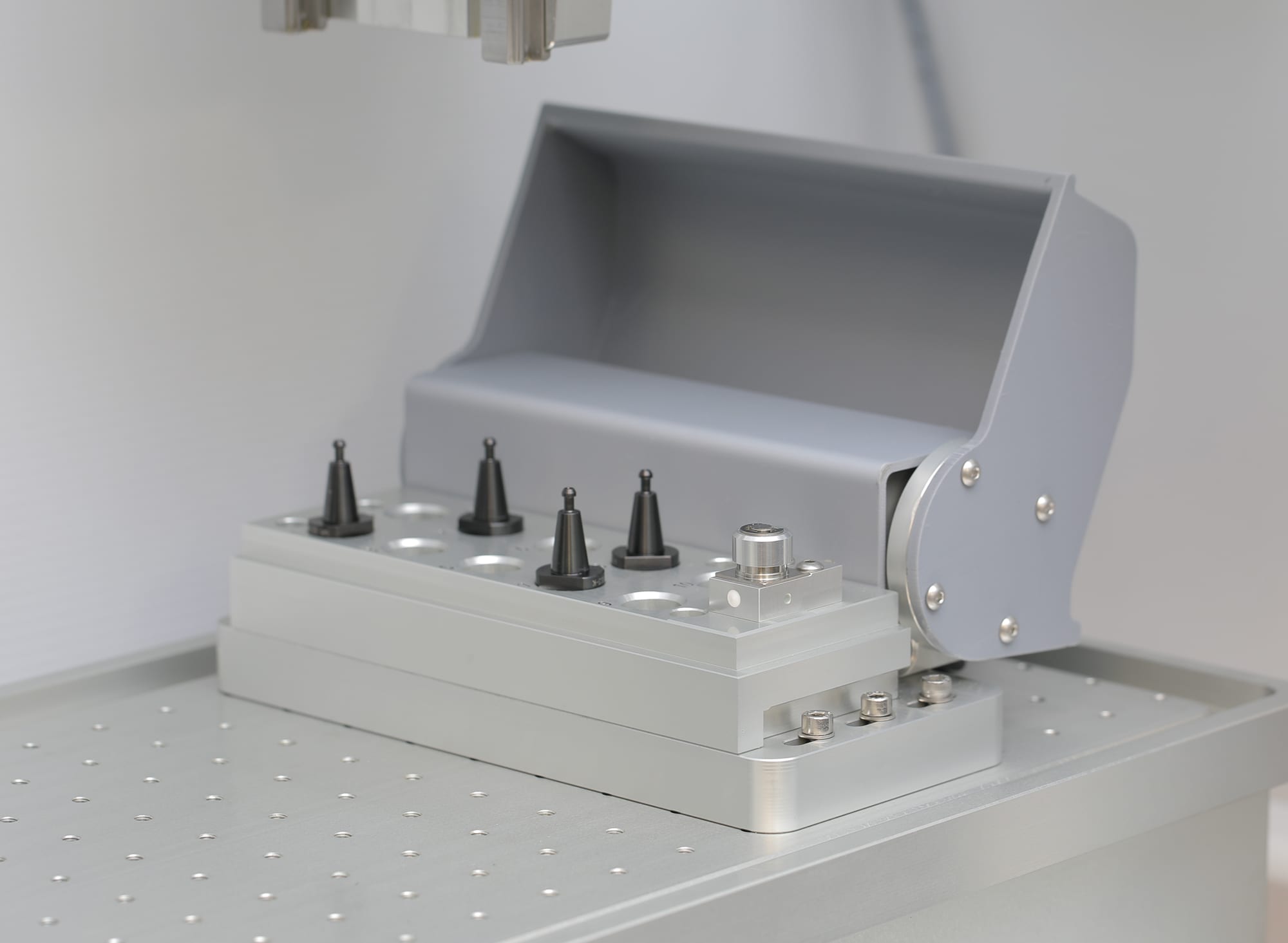
During each tool change, the tool length is automatically measured to ensure machining precision and reduce setup time. A protective cover shields the tool pots from chips and contaminants.
Tool clamping and unclamping is controlled automatically through NC machine code, or manually via a dedicated button on the front panel or the screen interface.
The X table carries threaded mounting holes at 25 mm intervals to integrate modular fixtures, rotary heads, and sub-tables.
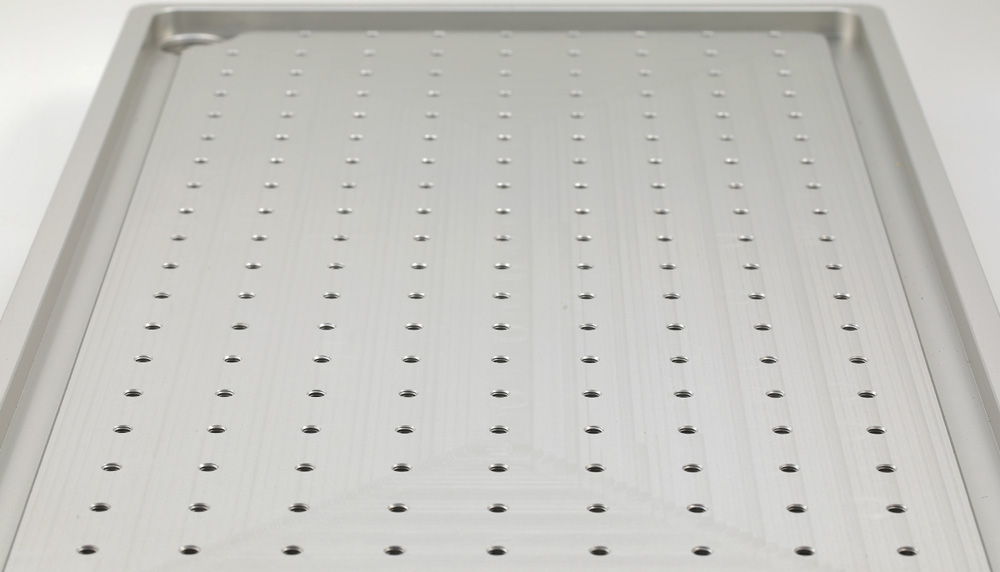
Users install workholding devices, sub-tables, rotary heads, auxiliary spindles, and custom accessories wherever the job requires. Compatible fixtures from NS CNC carry matching hole patterns at 25 or 50 mm intervals.
A machined drainage groove around the table perimeter and two dedicated drain holes manage coolant during machining.
Positioning accuracy and repeatability within 1 micron - for fast, repeatable workpiece exchange.
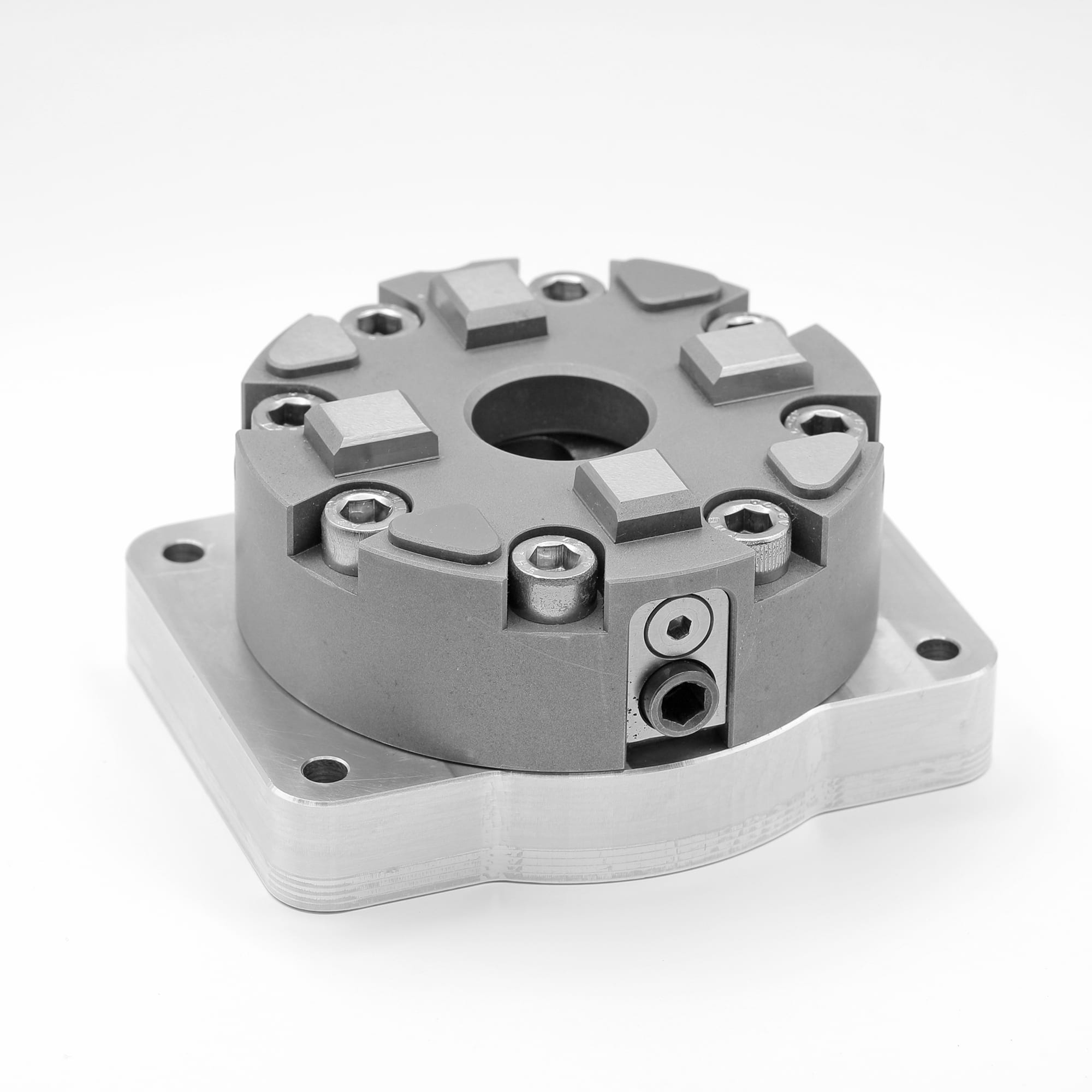
The system consists of a base mounted on the machine and a removable pallet for the workpiece or fixture. Both parts carry a precision mating seat for accurate, play-free alignment when the pallet is reseated.
The pallet is secured manually with a clamping bolt; an optional pneumatic clamping system is available for automated or high-production applications.
Designed for mobility and stability - heavy-duty casters for repositioning, integrated leveling mounts for cutting.
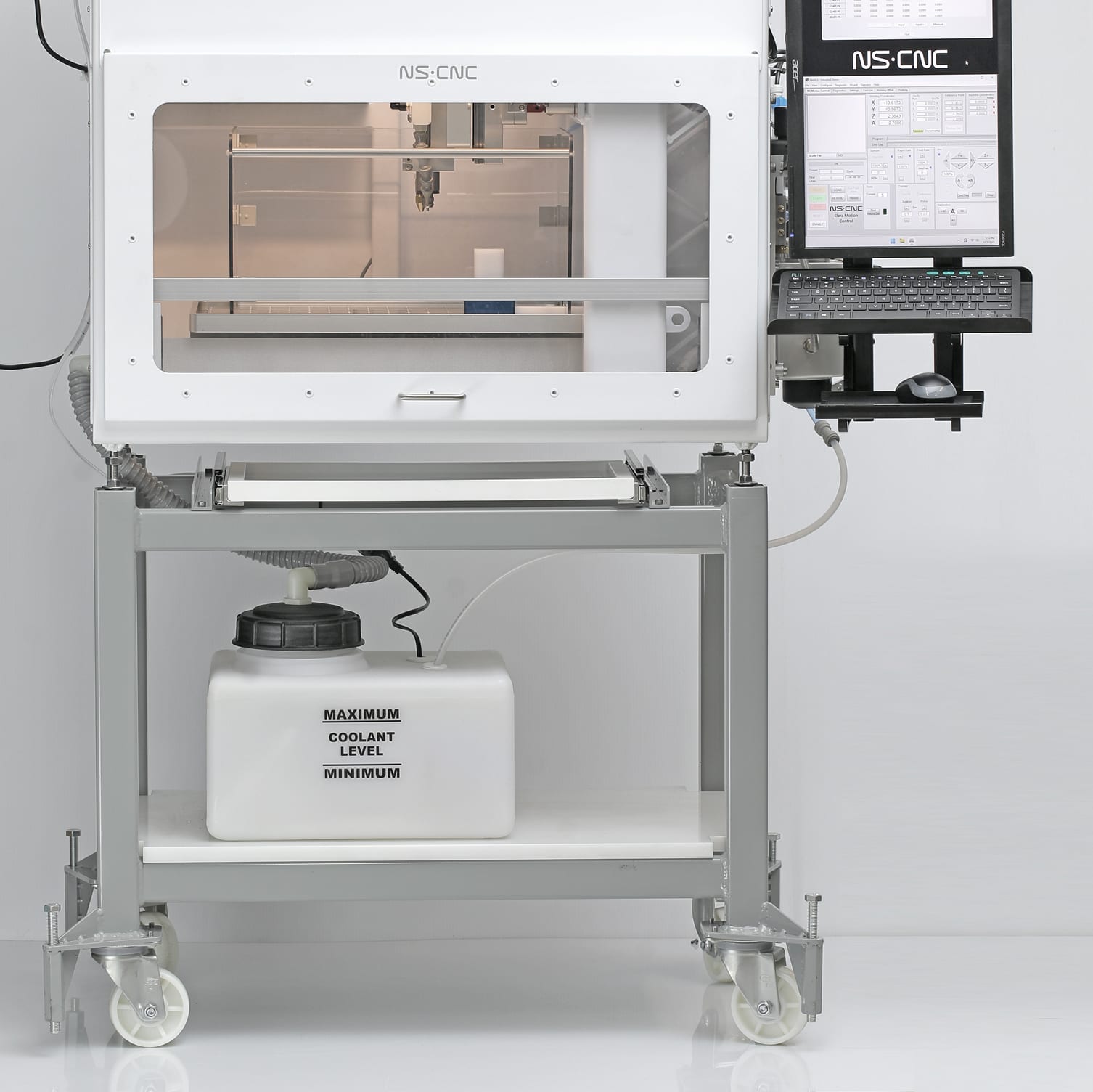
Heavy-duty casters move the machine around the workshop; once positioned, the leveling mounts lower to lift the stand off the casters. Because the mounts sit slightly outside the machine footprint, they maximize rigidity and reduce vibration during machining.
A lower shelf is sized for the coolant tank, and a pull-out tray holds tools, milling cutters, or accessories such as a keyboard and mouse.
Real setups on the 25 mm grid - probing, indicating, fixturing, and cutting in the same enclosure.
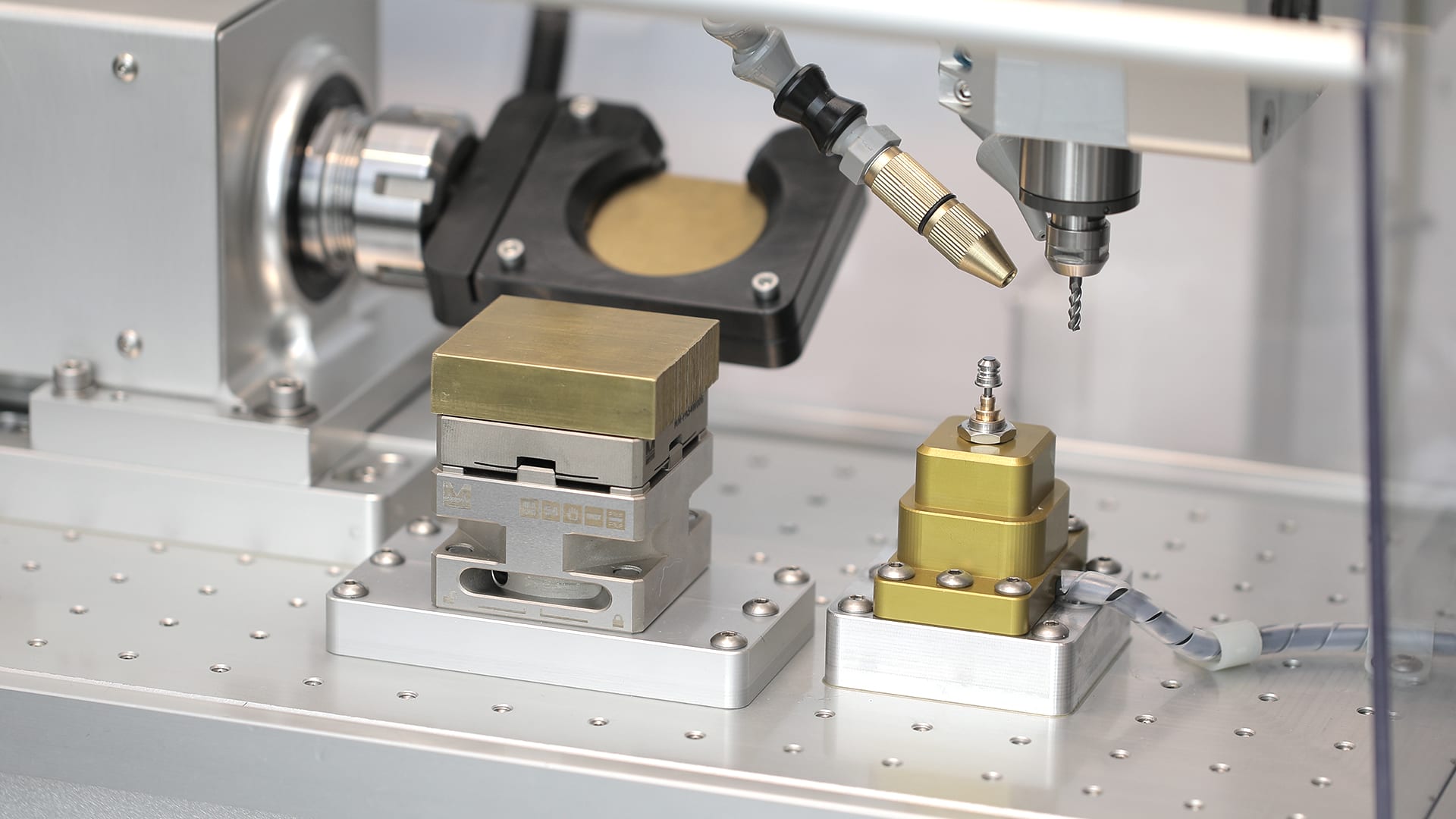
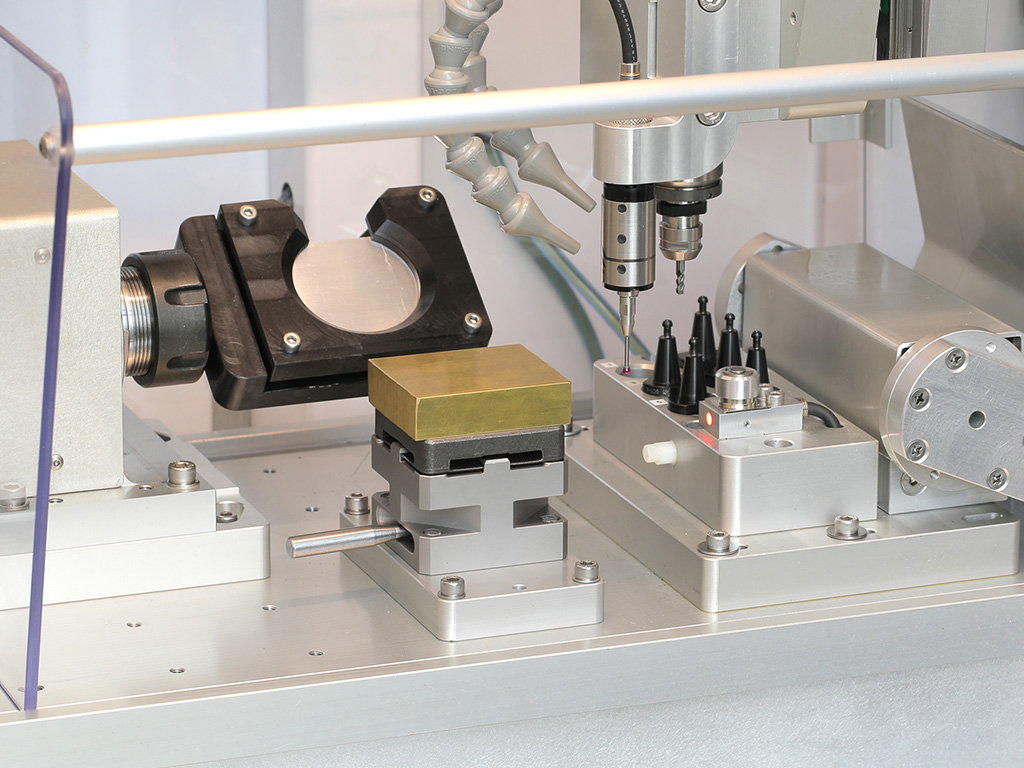
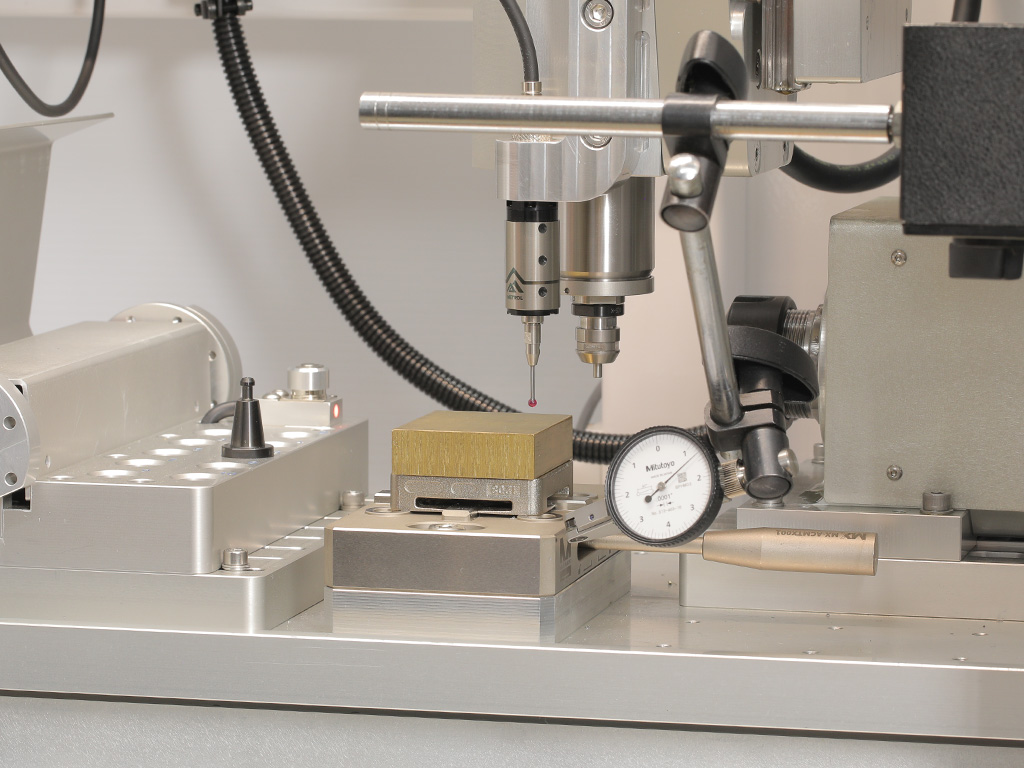
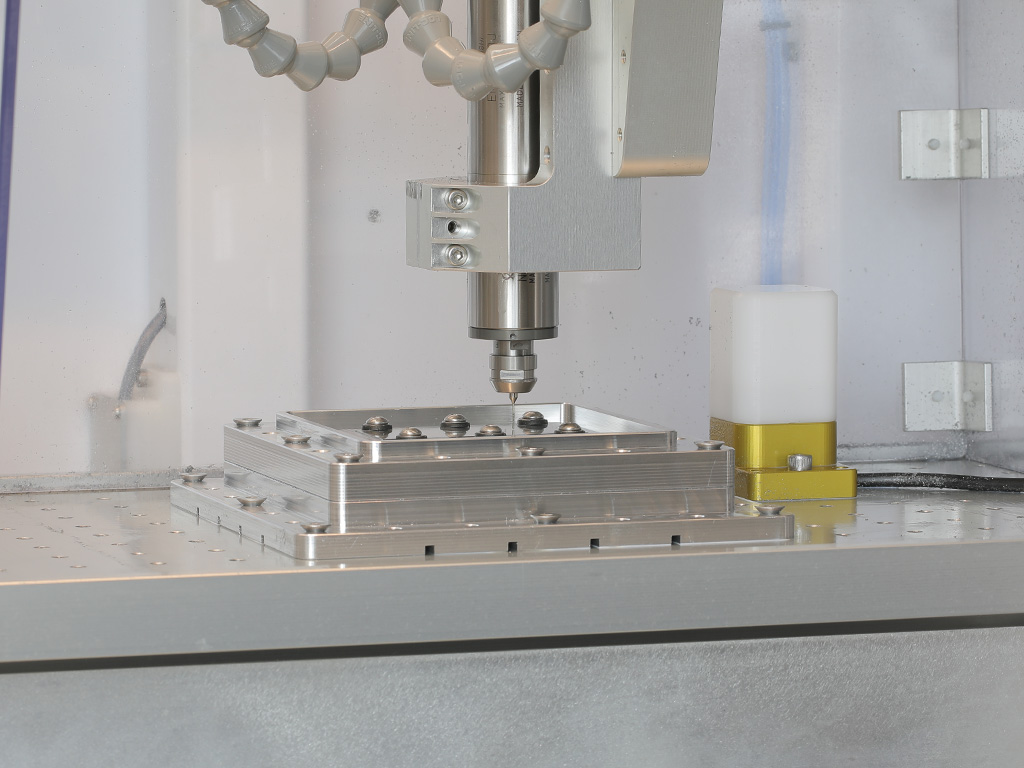
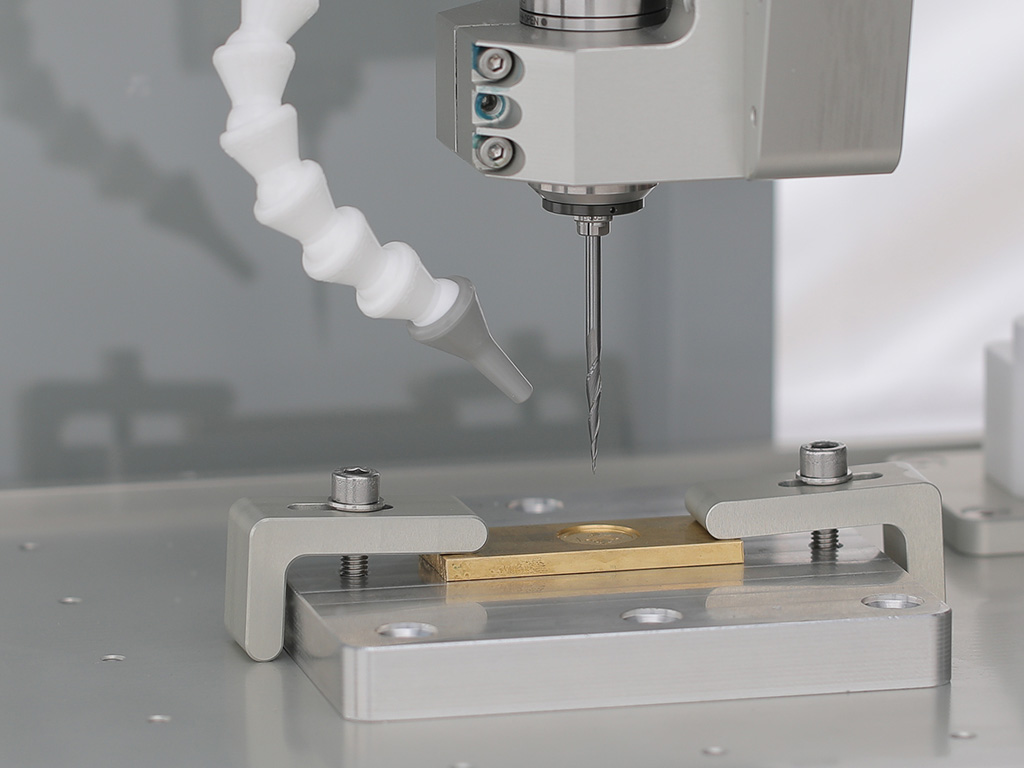
Spindle, rotary head, workholding, controls, and coolant in a 33 × 22 × 38″ footprint. The numbers reference the photo.
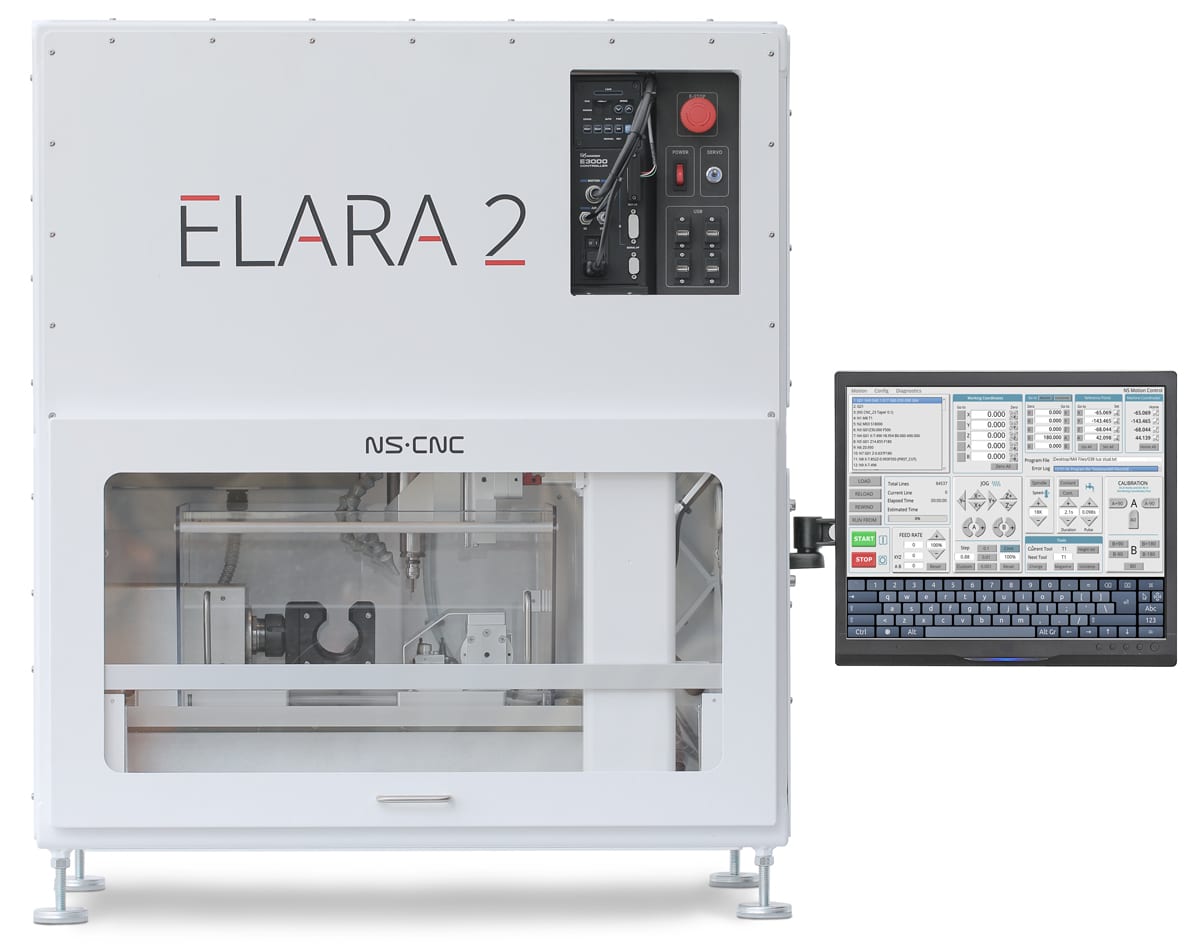
An E3000-series spindle rated to 60,000 RPM with cutter tip runout of less than 1 micron. Three standard options cover soft materials, metal milling, and automatic tool change.
On 4-axis configurations a rotary head mounts on the X-axis, enabling combined 3-axis and 4-axis milling operations. Both rotary and flat work run in the same setup.
Threaded mounting holes at 25 mm intervals integrate vises, modular fixtures, rotary heads, and sub-tables. A machined drainage groove and drain holes manage coolant.
The spindle controller, power and servo switches, USB ports, and the emergency stop are physical controls on the front panel - not menus buried in a screen.
The machine is driven from a monitor on a swing arm. Tool clamping and cycle control run from the screen interface or the dedicated front-panel buttons.
A full enclosure with a viewing window keeps chips and coolant contained - the self-filtering liquid coolant loop circulates from a 23-liter tank.
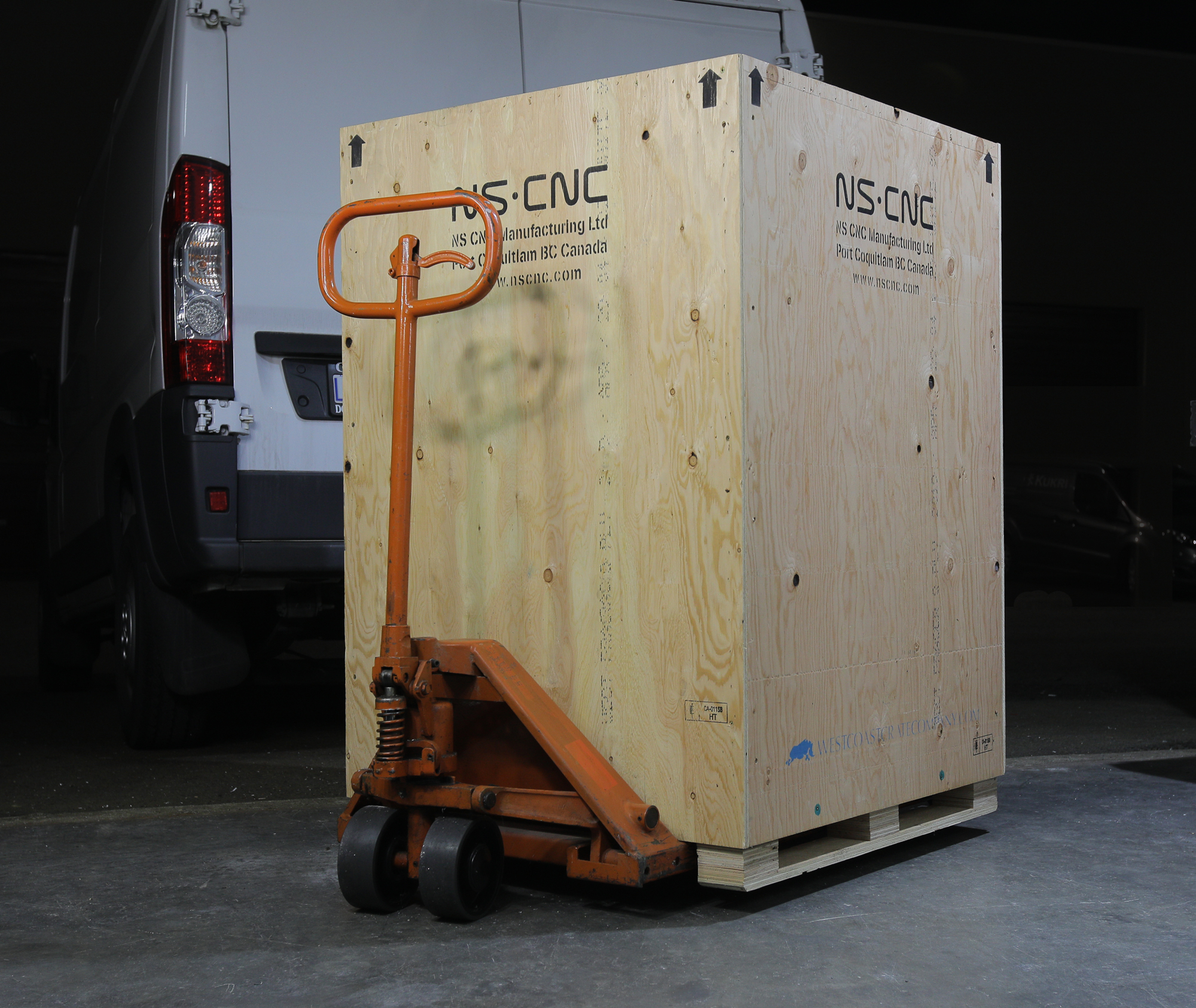
Every Elara 2 ships assembled and calibrated, with the software, tooling, and start-up supplies to begin cutting.
3-axis is the standard configuration for flat part milling - the workpiece clamps directly to the X carriage to maximize stability. Adding the ATC automates bit swaps but requires a compressed air supply. 4-axis adds a rotary head (A-axis) on the X-axis, enabling combined 3-axis and 4-axis operations. 4-axis with ATC is the most advanced standard configuration and assumes extensive operator experience in CNC machining.
Materials ranging from waxes and plastics to hard metals and ceramics. The spindle choice matters: the E3000 3060 QC is for soft materials only, while the standard E3000 3060 is built for metal milling and stays durable in dirty environments.
Milling cutters and drills with diameters as small as 5 microns - roughly one-fourteenth the width of a human hair. That capability is used in microfluidics, miniature device fabrication, and precision instrumentation.
E3000 3060 QC - quick lever tool changes, soft materials only, collets 2.0–4.0 mm. E3000 3060 - the standard for metal milling: wrench tool changes, collets 0.5–6.35 mm, durable in dirty environments. E3000 3060 AQC - pneumatic tool changes for use with the ATC; requires an air supply. Custom spindle options are also available.
Yes - it is a pneumatic system requiring 21.7 to 36.2 psi. Tool length is measured automatically at each exchange, and a protective cover shields the tool pots from chips and contaminants.
With Quick-Release Holders, positioning accuracy and repeatability are within 1 micron. The base stays mounted on the machine; the removable pallet carries the workpiece and is secured by a manual clamping bolt - or an optional pneumatic system.
Working distances are 230 mm in X (127 mm with the ATC installed), 180 mm in Y, and 127 mm in Z. If your parts are bigger than that, talk to us - a custom configuration may fit better.
110 or 220 VAC at approximately 1,000 W - an ordinary outlet. The machine measures 838 × 560 × 965 mm and weighs 200 kg. A sturdy bench works, or the optional stand adds casters, outboard leveling mounts, a coolant-tank shelf, and a pull-out tray.
Machining demonstrations across NS CNC machines - including the Elara 2 milling metal on camera.
Send a part drawing - material, dimensions, tolerances. We’ll tell you whether it’s an Elara 2 job, which configuration we’d run, and what the machine costs.
The Elara 2 is sold direct through the shop; equipment financing is available through our financing partner.